
Basic information about nuclear power
Principle of operation of a nuclear power plant
Different Reactor Types
The roughly five plant options included in our tendering process are based on either pressurised water reactor (PWR) or boiling water reactor (BWR) technology — both of which are currently in use in Finnish nuclear power plants. Both reactor types can produce heat and electricity. Reactors designed to produce heat only are pressurized water reactors.
PWRs and BWRs share the same fundamental operating principle but differ in where and how steam is produced. A PWR uses a separate steam circuit, whereas in a BWR the steam is generated directly inside the reactor. Both are safe and widely used nuclear technologies.
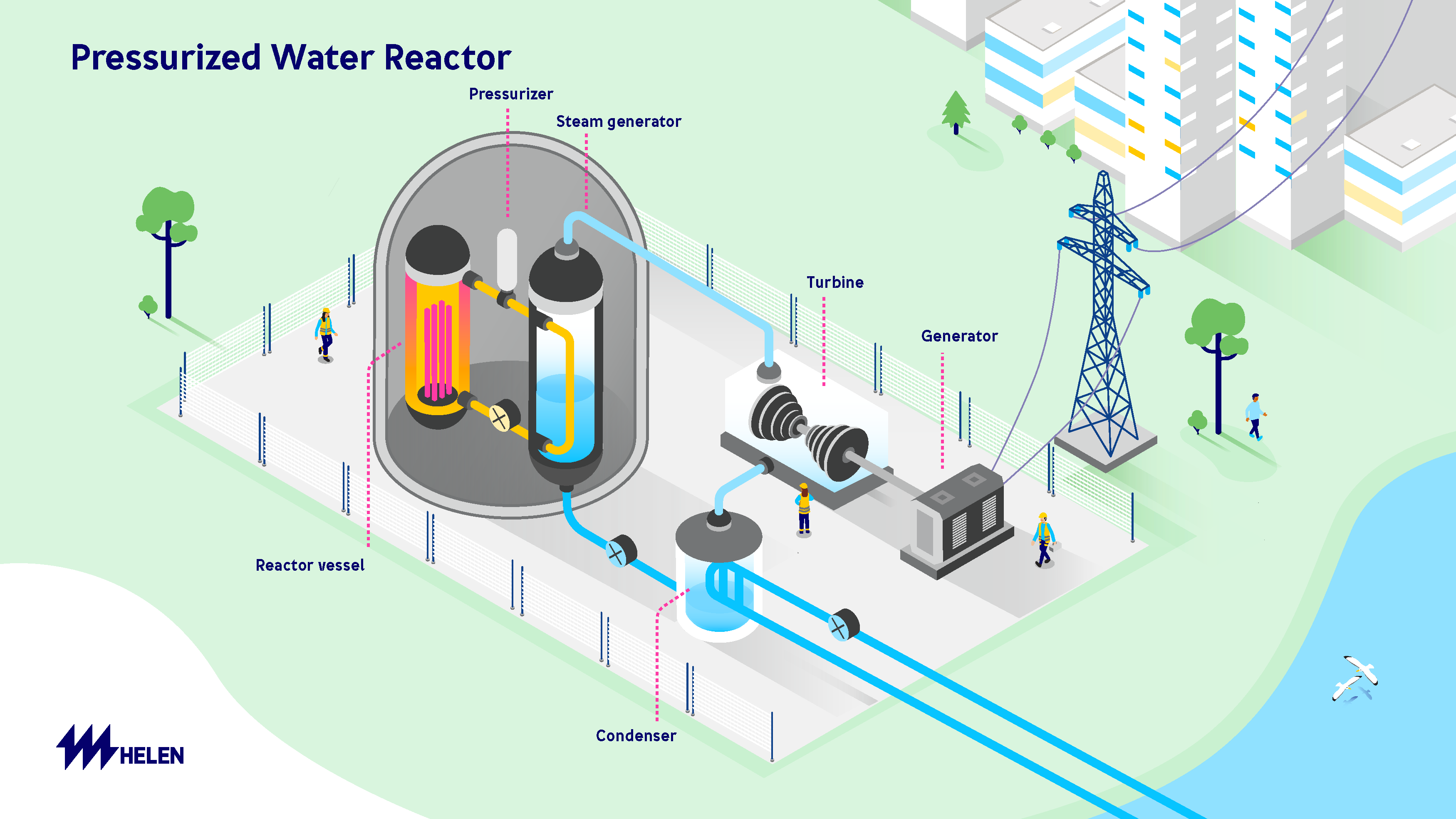
Pressurized Water Reactor (PWR)
Operating Principle
In a pressurized water reactor, the reactor core is cooled and the nuclear reaction moderated with water that is kept at very high pressure to prevent it from boiling. This hot water transfers its heat to a separate steam generator, where the secondary‑circuit water turns into steam and is directed to the turbine.
Key Features
- Two separate water circuits (primary and secondary)
- Reactor coolant does not boil
- The steam entering the turbine is non‑radioactive
- The most common reactor type in the world
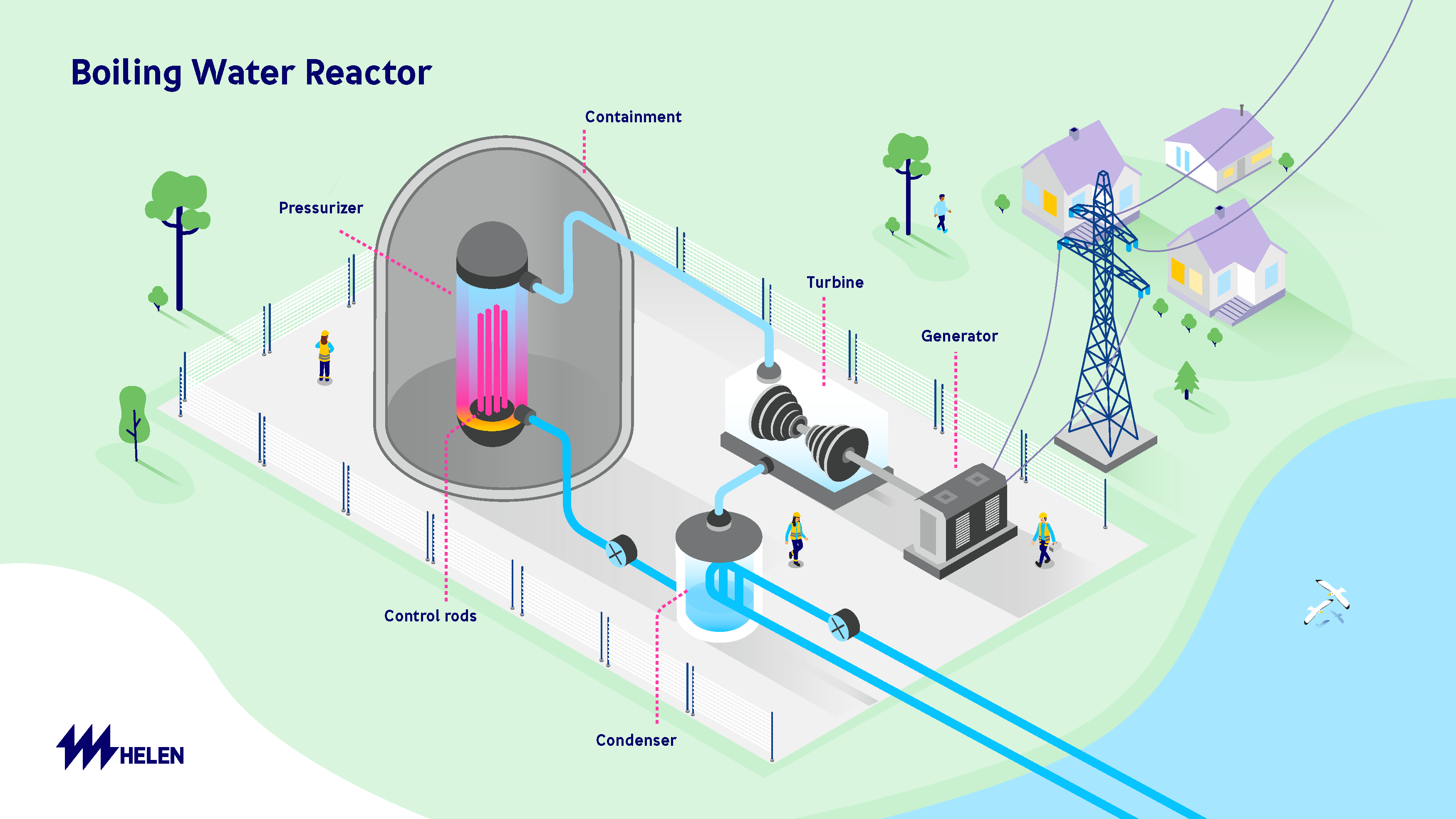
Boiling Water Reactor (BWR)
Operating Principle
In a pressurized water reactor (PWR), the reactor core is cooled by water that is kept at a sufficiently high pressure to prevent it from boiling. In district heating reactors, the temperature, and therefore the pressure, is relatively low, around 150°C and 10 bar. In combined heat and power (CHP) plants, the temperature exceeds 300°C and the pressure is over 150 bar.
Key Features
-
Single water circuit
-
Water boils inside the reactor
-
The steam sent to the turbine is not radioactive in a combined heat and power plant
-
Structurally simpler than a PWR